
100,000 Live Stakes Planted to Expand Riparian Forest Buffers
The Live Stake Collaborative has worked since 2019 to support clean PA streams
Selinsgrove, PA – Today, Chesapeake Conservancy and Susquehanna University announced that 100,000 live stakes have been collected by the Live Stake Collaborative for planting along streamside forest buffer restoration projects in Pennsylvania. This milestone, which equates to almost 40 acres of streamside planting, is a culmination of seven years of collaboration with partners across Pennsylvania.
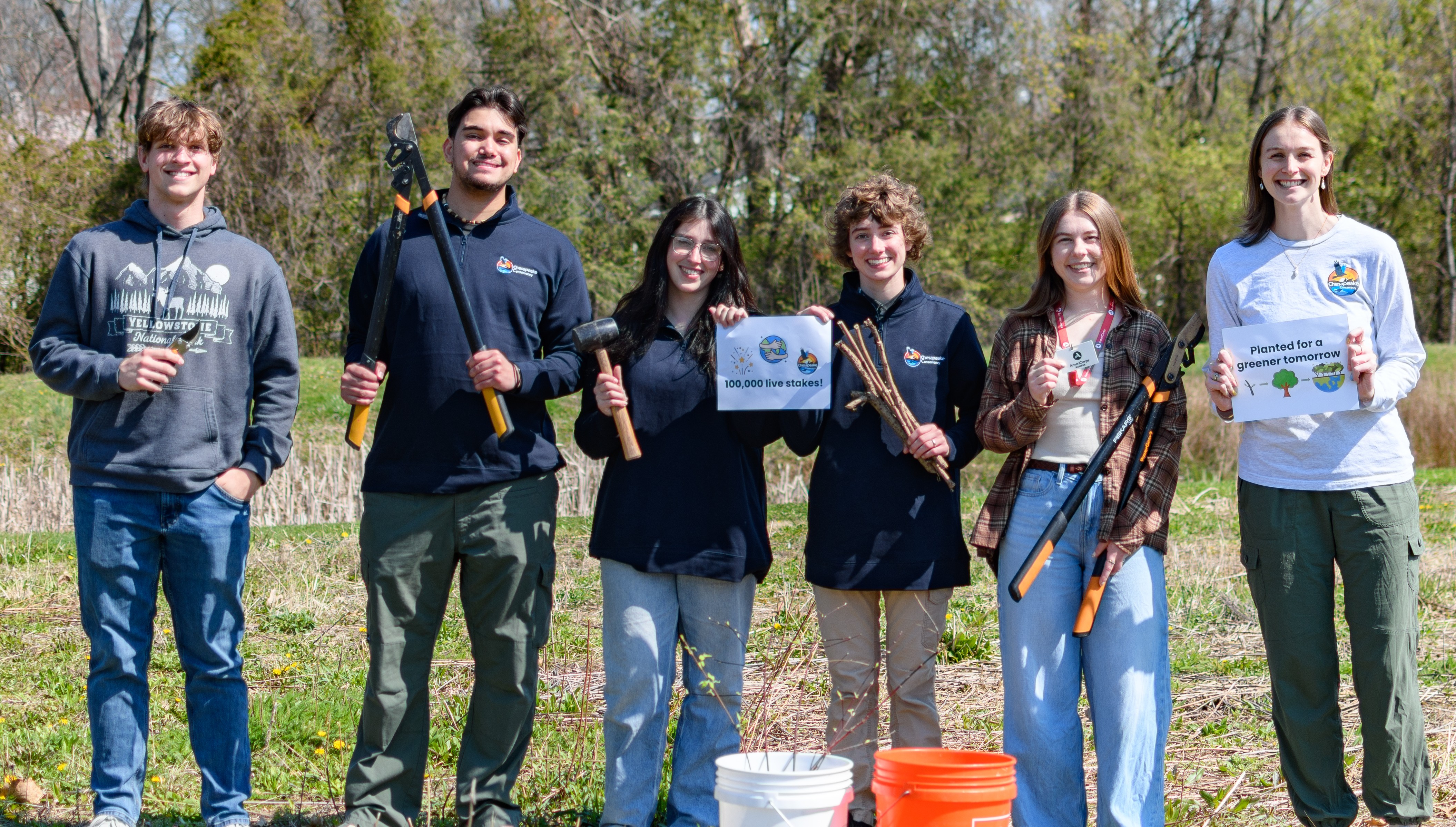
Live stakes are branch cuttings from wetland tree and shrub species that can be readily planted into the ground alongside streams. These plantings can stabilize stream banks, prevent sediment erosion and run-off, filter nutrients and support local wildlife habitat.
First founded in 2019, the Live Stake Collaborative was formed by Chesapeake Conservancy, Susquehanna University, the Pennsylvania Department of Conservation and Natural Resources (PA DCNR), Merrill W. Linn Land and Waterways Conservancy and Bucknell University to provide free plant material to partners to restore ecosystem and stream health. Since then, local partners have joined the collaborative or shown their support, including Juniata College, Clearwater Conservancy, Huntingdon County Conservation District, Union County Conservation District, Snyder County Conservation District and the Penns Valley Conservation Association. This work has been financially supported over the years by the National Fish and Wildlife Foundation, the Hamer Foundation, the 1994 Charles B. Degenstein Foundation, Foundation for Pennsylvania Watersheds and PA DCNR.
To further support the partnership, Chesapeake Conservancy has employed a live stake coordinator, typically staffed by a CORE Susquehanna AmeriCorps member in a year-long term. In addition, Susquehanna University has greatly supported the effort through on-site live stake storage and student participation. Each semester, Susquehanna University students across all majors earn class credit and volunteer hours by attending stake collection events. This engagement, bolstered by Chesapeake Conservancy student internships, creates a constant stream of University-supported efforts in collecting, transporting and planting live stakes.
With rigorous partnership support and a strong volunteer network, the Live Stake Collaborative has engaged over 1,000 volunteers, logged more than 3,800 volunteer hours and hosted 129 events. The collaborative has seen significant success over the years, with substantial buffer growth at many planting sites.
The Live Stake Collaborative has expanded its efforts by providing training to organizations in Maryland who are developing their own live stake programs through partnership with the Climate Crew Network, a joint partnership between Chesapeake Conservancy and the Greater Baltimore Wilderness Coalition. Based out of Baltimore, the Climate Crew Network provides job seekers with green job training, field experience and industry exposure. Additionally, the Live Stake Collaborative offered support and resources to partners through a full program StoryMap and Tree and Shrub Identification Guide for Live Stake Harvesting.
“The live stake program has a direct impact on local streams, surrounding communities and the Chesapeake Bay watershed. When you improve the health of a tributary, you’re also providing downstream benefits to everyone along the waterway,” said Michaela Rolecki, Chesapeake Conservancy’s volunteer coordinator and 2025 Susquehanna University graduate. “We’re grateful for the many partners and volunteers who have supported this effort. The Live Stake Collaborative is an ambitious group, and we’re already shooting for our next goal – 200,000 live stakes.” In addition to her role with Chesapeake Conservancy, Rolecki has also established a monarch butterfly waystation and pollinator garden on the campus of Susquehanna University.
If you’re interested in getting involved with the live staking initiative in any capacity, please contact Chesapeake Conservancy’s live stake volunteer coordinator, Michaela Rolecki at mrolecki@chespeakeconservancy.org.
Feature Photo by Brodie Bard


